Wednesday, February 27, 2008

The Good, the Bad, and the Universal


Hsun-tzu believed that human nature was inherently bad. Hsun-tzu derived this belief by focusing on the biological aspects of humans. He believed that the biological make-up and tendencies of humans were the truest aspect of humanity. Our nature is to procreate, kill, and eat. Man is born an animal, which needs training to curb biological urges. He starts by looking at the masses for his norm of human nature. He saw very appetitive creatures and believed that humans needed to be trained by an externalized manifestation of li. This external li would control the bad nature of the body. His conception of li originates from past sages who created the concept to make people follow the rules of propriety. Propriety restrains the biological self by externally requiring people to behave properly. Hsun-tzu’s belief of curbing our bad human nature leads to authoritarianism, which gave birth to the legalist, who tried to administer li through the power of government. Through the state and socialization, li is used to render people more sage-like. Li was engrained into the people through education, rites, and discipline. This was the only way to curb the biological self, because the biology can never be at harmony with the spirit. Thus authoritarian rule must change the person in order to have any hope of harmony.


An example of Hsun-tzu’s human nature is Freud’s superego. Hsun-tzu’s external manifestation of li to control the biological appetite of the masses is like the superego regulating the id. The id is an impulse driven appetite that only sets out to please the phenomenal self. The superego represents societal norms and morals. The superego must be forced into a child’s head through education, discipline, and rituals. Once the superego starts working, the child will feel guilt for id-driven urges. Thus the child will become a socially stable creature.

Critique:
Mencius, when faced with Hsun-tzu’s theory on human nature, found it unnatural. A Hsun-tzu follower, Kao Tzu told Mencius that making morality out of nature was like making cups and bowls out of willow. Mencius refuted by pointing out that one must mutilate the willow to make cups and bowls; one can’t do it by following its nature. To Mencius, Hsun-tzu’s theory would be mutilating men and their natures to make them moral. In Hsun-tzu’s view, the body can never be at harmony with the spiritual self, so it has to be controlled externally. Mencius felt that li came from inside a person, which means the body and spirit need to reach a balance to be at harmony.


B. Mencius believed that human nature was intrinsically good. He held that if Heaven makes all men, then there is a standard that Heaven has engrained into them. With Heaven’s standard comes a natural self that is good. Humans possess an innate capacity for good and knowledge of what is good. Li is latent within man and therefore does not need an external force to bring it into man’s nature. It is merely a part of it. Mencius illustrates that water’s nature is to flow downward, just as man’s nature is pointed towards the good. He admits that an external force can keep water from flowing down, but it is hardly natural. He believed that to be truly human, a person must follow their nature, which is germinated in the Four Hearts. According to Mencius, every human needs the Four Hearts to truly be human. The first heart is the heart of compassion, which awakens empathy. The next one is the heart of shame, which makes an individual ashamed of failing to be dutiful. This forces humans to create aspirations. Third is the heart of courtesy and modesty, which is imperative in affirming the other. The final heart is the heart of right and wrong, which teaches the difference between quantity and quality. If a person can manifest these Four Hearts, they will be acting to their full nature. However, if they do not have these hearts, then the person is not a human. By aligning oneself with his or her original nature, the latent li starts to work through the person. If the person fully manifested the Four Hearts and strived for wisdom, they may be looked at as a sage. Mencius regarded the sage as the norm of humanity. Mencius thought one could find the full embodiment of human nature in the sages, because they are the pinnacle of what man is capable of.


A child is born with the Four Hearts built in. The child first takes on the heart of compassion when playing with his or her various dolls and stuffed animals. The child’s imagination makes the toys real and feelings will be created for them. If the toy is sad, then the child will be sad. A child’s first step to being human is empathy. Being empathic, the child must be courteous to others. With the heart of courtesy, the child will be successfully affirming the other with good manners and small human interactions such as greetings. As the child gets older, the heart of shame reveals itself. The child will feel bad for not doing as much as he or she can. A less-than-desirable grade in school will give the child drive to do better. Soon, when the child matures, the heart of right and wrong will surface. He or she may be confronted with the temptation to steal or to lie. A person, in the face of these choices, must make the right decisions and will become wise for doing so. This will also give the person the ability to differentiate between what makes quality and what is a product of social consensus (quantity). The person’s human nature will be pulsating with li and the person will be on the path of the sage.


Critique:


When Mencius looks at the sage as the normal example of human nature, he is not being realistic. When I look around, I don’t see many sages. They are referred to as ancestors throughout Confucian works. Creating an ideal based on people who lived long ago doesn’t take into account how people live today. The Four Hearts are the product of idealistic thinking and not reality. Humans are animals and need to be socialized.


C. Mo-Tzu’s doctrine of universal love is a way of eliminating family loyalty. His doctrine calls for everyone to love each other without distinction. The love Mo-Tzu refers to is not the Christian type of emotional love, it is a love created from intelligence. Mo-Tzu championed mental love, but rejected emotional love. Eros love, which is based on emotions, was ignored for agape love, which is his love of the mind. This love is defined as loving the other in the way and the sake of the other. To do this Mo-Tzu must take out the individual other and turn the other into humanity. One no longer loves for the way of the other, but loves everyone the same way. Love of the mind becomes a duty to humanity, which defines what humanity needs through law. His doctrine took on a utilitarian form because it required people to love everyone with the same intentions and work based on duties. You cannot love your child, for being your child; you have to love it for being a human along with a complete stranger. The needs of humanity are summed up in Mo-Tzu’s five goods, which are enriching the country, increasing the populous, bringing about good order, obtaining favor from the spirits, and preventing aggressive war. These things are supposed to be sought universally. The five goods must be enforced by a ruler. The people are made to understand why they need to believe in universal love.


The military unit is an example of Mo-Tzu’s doctrine of universal love. They must love the unit mentally, because an emotional love could get in the way of the unit’s duties. They all have a duty to each other to keep the unit alive and running smoothly, which is regulated by military law. For instance, risking the entire unit to save the life of a single comrade is prohibited. This demonstrates the mental love for the whole of the unit as opposed to emotional love for a close friend. The military unit is utilitarian because it uses law to instill duty equally, rather than placing emphasis on the individual.


Critique:
The Confucian objection to Mo-Tzu is in his destruction of the individual. Confucius believed in affirming the other through agape. His objectivism involving individuals would put him at odds with Mo-Tzu’s generalization of all human needs as defined by their duty. Mo-Tzu throws a blanket over the individual. Therefore, there can be no objectivism when looking for the good of the people. Mo-Tzu’s system would need to look to the ideals, which become laws that regulate the needs of humanity. By looking at laws instead of the individual’s needs, they lose any chance of doing what is truly good on an individual basis.

Confucian Harmony

A The superior man or the Chun-tzu is a man that stands in awe of three things. First he stands in awe of the ordinances of heaven. By doing this he knows where his power and influence stops and heaven’s surpasses his. Second, he stands in awe of great men, so the superior man can recognize when his contributions end and the great men supersede him. Third, the superior man will listen to the words of the sages. By recognizing the greater knowledge of the sages, the Chun-tzu will be in a constant state of reception of their wisdom. The mass man, on the other hand, seethes in mediocrity and is content with it. The mass man can’t live by the laws of heaven because he doesn’t know them. Mass man will disrespect great men and shrug off the words of the sages. The mass man won’t strive to attain anything greater than the average. He believes anyone above average is only there by social constructs and other external factors such as wealth. The mass man sees the norm of a person in the middle of the bell curve, while the superior man sees the norm of a person in the great men, or full manifestations of humanity. The mass man only tries to be average; therefore he will have no shame for his lack of education or wisdom.

A superior man is Thomas Jefferson. He stood in awe of the ordinances of heaven, so much that he felt compelled to draft his own version of the Gospels. Jefferson also stood in awe of great men and heeded the words of the sages. This can be seen in his writing which is heavily influenced by John Locke and Montesquieu. One day, a student in history class will be in awe of Jefferson and exclaim, “Jefferson was a genius.” Another so-called student, a mass man, may sneer and say “Jefferson was an elitist.” The mass man will throw the word elitist at anyone extraordinary. They seem to dislike it when greatness is juxtaposed against their averageness. Being content in the mundane bell curve, they will reduce the outliers to their socioeconomic status, the century they were born in, and terms like “elitist.”

B Confucius believed we were all born with a fate. Fate is what is given to a person, like ones sex, class, parents, and other unchangeable factors received at birth. With each fate there is a destiny. Destiny is a call to go beyond fate to a higher quality of living. This will raise a person above the mundane fated life into the spiritual life. The original state of a human was spiritual, which then became complicated in the mundane world and created an imbalance between the tranquil spirit and the phenomenal self. To balance the complications, one must use sincerity to reach harmony between the two. This is essential to one’s destiny, which becomes realized when harmony rises to the surface in all of your actions. Sincerity is a pure act of attention that will give you a singleness of mind when responding to the other. This attention is not spent on the personal or social level. These levels focus on the self. For instance, the personal level would only focus on the individuals own feelings, not the other’s. The social would only reveal something about a person against the backdrop of society. The attention Confucius writes of is spiritual attention. This is a non-attached attention, which lets a person objectively attend to the other. By having a singleness of mind when listening to the other, a person sheds their own biases. This will bring out the good in people and the self, creating harmony.

Fate and destiny can be exemplified in Siddhartha Gautama. He was born a prince with wealth, women, and a father willed him to become a world conqueror. His father blocked him from the outside world so he could never see death or suffering. This did not work and Siddhartha Gautama took the journey to realize his destiny. He had to walk away from all the riches to rise above his fate to his destiny. After finding the right path, he took what was offered by the cosmic forces and reached a new level of enlightenment. His fate as a prince was rooted in the mundane world, but his destiny allowed him to live the ordinary life in an extraordinary way. When it comes to the three attentions, we start with the personal level. Someone operating on the personal level of attention is only focusing on their self. This leads to them judging the situation with their feelings, not objectively. The social level of attention can be seen in someone who constantly worries about his lot in society. The person will only judge their position in society against others. The spiritual or non-attached attention is attained when the self lets go of his or her biases and objectively listens to the other.

C The doctrine of the rectification of names originated from Confucius’ belief that words had lost their essecial meaning. He thought the word must symbolize the essence of the thing it names to embody it and truly be a name. Words are not used as a simple communication tool; they must be used analogous to the thing. This doctrine lends its hand to the 5 relations, which are friend to friend, sibling to sibling, husband to wife, parent to child, and ruler to subject. By rectifying names, it gives these five relations meaning. By knowing the right word for father it leads to the essence of it. By knowing the essence of something, a child can be a better father or relate to your father. It allows a person to pay attention to the essence of fatherhood. By knowing the essences of the five relations one can better embody those roles in life. By embodying these roles li can fully operate in the relationships, which leads to harmony. Harmony comes from li bringing out the latent spirit within a relationship.

When I think of the doctrine of the rectification of names, the word mother comes to mind. It is usually one of the first words expressed as a child in short form as mom. The word gets to the essence of what a mother is. When said, it inspires a feeling of security and warmth. This word reveals the essence of a mother, which gives a child’s first words merit. If anyone understands what a mother is, it is her child. The mother also knows what her title entails and acts out on the parent to child relationship sincerely. If all people could get to the essence of what it is to be a friend, a parent, a child, a sibling, or a ruler there would be harmony in all relationships.

Critique of A:

The mass man could be right about everyone being equal. No one’s exploits of opinions should be held higher than their own, because everyone is entitled to their own feelings. Hard work has very little to do with success. It is mostly determined by socioeconomic status and other social factors. By saying that, anyone who is not equal in tastes or ability is elitist. The mass man would say that his tastes are just as good as someone who has sought after good taste in a subject.

Critique of C:

Sociologists argue that language is a tool for man to operate as a social creature. Words are just labels we assign to objects and are only valid through social consensus. In this view, there is no way to go beyond language, because it constructs our reality through labels. They would say any spirit we feel from a word’s relationship with the object is from the constant use of the word in our society. We just start to recognize an object by the word so much it seems to touch it essentially, but it is actually just from habitual use.

Wednesday, February 20, 2008

The Stand

The dusty road seems forever.
Men, women, children take their leave.
Shops lock, stocks lock, guns shake.
One man’s nervous hand
Steps out to make his stand.
The barkeep shakes his head.
The barber thinks him dead.
The whore pleads for his life.
Everyone turns away, even his wife.
The escaped killers ride.
The sun falls on their back.
A red sun.
The fires of hell are overdue.
The man hears time as it passes.
He listens to everything he loved.
With the snap of a Schofield
Bullets fall into six steel coffins.
The gun cocks and he feels his wife’s lips.
He can smell the whore’s perfume.
He can taste the barkeep’s whiskey.
He feels the barber’s razor
.The fires of hell roll in.
He stands alone
Face to face with hell.
He cracks an uncanny smile.
Four horsemen drunk with power break leather.
The man skins his smoke wagon.
Smoke and fire explode in the streets.
The killers sober at the rip of the bullets.
“Damn he’s fast” screams a wounded man.
Six dead ears hear nothing.
The lone man.
The deputy.
Stands above the wounded man.
Mercy, begs the coward.
Schofields snap back into leather.
He was fast
Bullets were faster.
The man falls.
Five dead men lay in the street.
A widow curses.
A whore cries.
He stood where no one else would.
A man has to do what a man has to do.
In the face of hell’s fire.
He didn’t flee.
What’s that say about me?

Monday, January 7, 2008

Wicked Review


Wicked is a musical based on the novel by Gregory Maguire. The musical portrays the characters from The Wizard of Oz in a perspective quite different from how they were originally presented. It re-imagines the classic story from the point of view of Elphaba, who becomes the Wicked Witch of the West. The post-modern approach to Oz is disappointing. Instead of augmenting the original film, the writer merely alludes to it and turns away from it. The musical numbers were mediocre for this caliber of musical. The songs/dances sounded/looked the same—all in dire need of raw emotion. What Wicked lacked in music, it made up for in full force with set design, effects, and lighting. These elements were flawless and crafty, enveloping us in this newly-imagined, though feigned, universe of Oz.
The greatest disappointment concerning Wicked is the scale and setting of the story. With the original Oz, we had the tale of an epic journey in the same tradition as the Lord of the Rings. Wicked, on the other hand, was the equivalent of a 1980’s John Hughes’ high school drama. Wicked claims to be the untold story of the Wicked Witch. Reflecting on The Wizard of Oz, I see the Wicked Witch to be true evil, not a misunderstood green girl. I may be an Oz purest, but it was upsetting to see the Scarecrow embrace Elphaba in the end of Wicked. The story of young Elphaba suffering racism and stirring activism to end animal cruelty could survive without being stapled to the world of Oz. Instead of thoughtfully utilizing the story’s existing themes and character development, Wicked only uses them as a spring board. It then springs far away from Oz, by making the Wicked Witch misunderstood. The original film viciously depicts her evil nature, while Wicked flips it around. Glinda is rendered a popular moron who is evil in her selfishness, leaving Elphaba as the victimized outcast. The use of the Lion and Tin Man were also annoying, considering the musical never comes to terms with the Witch being the center of their despair in the original Oz. The one element I thought was well-played is the idea of the Wizard being the architect Oz’ downfall. What kind of guy stands behind a robot head and yells at you? The kind of guy doing bad things from behind the curtain.
Since the release of Wicked, its popularity has seized the attention of countless families full of children. Outside of the theatre, one hears talk of its amazing music and how every member of the family has a copy of the soundtrack. I wasn’t impressed. The musical numbers felt redundant with no real emotion behind them. Instead of propelling the story, I felt like they took me out of it and put me in a trendy pop music video. Every time I heard Elphaba and Glinda sing with each other, it reminded me of a 13-year-old girl listening to her pink IPod. The next tracks had to be from Hannah Montana or the Cheetah Girls. Not to say that any of this is poor quality; it just doesn’t resonate with me. The end of the first act was by far the best musical piece in the show. When Elphaba rushes off stage and comes back flying in with lights beaming through fog, the music takes a downturn into a darker melody. If Wicked offered more moments where the music represents the psychology of its characters rather than the characters just singing along the music, it would have been a much stronger show.
The magic of Wicked wasn’t in the music or story, it was in the set design, effects, and lighting. The set transitions flow perfectly and the audience hardly notices, as gear panels slide out and beds appear from thin air just in time for witches to jump onto them. The special effects were an achievement for the stage. The first thing we see is a smoke-breathing dragon flapping its wings and whipping its head around. Then, monkeys fly from vines in front of a giant fantasy clock that a Dungeon and Dragons fan would want as a center piece. Next, we see a witch in a radiant gown float down on a bubble-blowing contraption. And Elphaba, in her witch hat, flies her broomstick through gleaming smoke. On all occasions, my mouth dropped. The stage design was perfect; they must have had the actual Wizard of Oz on a laptop controlling it all back stage, laughing to himself as people’s eyes lit up in amazement. To augment these moves, they had extremely well-planned lighting schemes. These allowed them to easily transition us into another scene or to make a special effect appear magnificent. Again in “Defying Gravity,” the light beaming through the smoke as Elphaba flew above the stage was masterfully orchestrated.
On stage, Wicked fails to grasp my heart as it did for most people, but the magic off stage with the effects and set design held me enough to appreciate the musical. The music was just too poppy for my tastes and seemed to lack passion. Finally, the story deceived The Wizard of Oz instead of playing off of its themes and enhancing Wicked’s relationship with the film.

Monday, November 26, 2007

Metal Enlightenment: Review of Heaven and Hell

The “Dio Era” of Black Sabbath returns under the guise of Heaven and Hell. The reunion of the geniuses behind albums such as, Heaven and Hell, Mob Rules, and Dehumanizer marks the revisiting of true metal music. This was exemplified by Heaven and Hell’s appearance at Irvine Meadows. The band, led by singer Ronnie James Dio, created a wall of metal that assailed the audience’s senses like the siren-seducing Odysseus. Tony Iommi, one of metal's greatest guitarists, shredded off more than a few blazing solos. Geezer Butler worked his fingers like a madman on bass. And the epically fast drummer, Vinny Appice, destroyed any noise ordinances within a five mile radius. The pinnacle of the concert was the band’s new take on their most famous song “Heaven and Hell.” There is only one thing to say about this return: hell yeah.
“Mob Rules” opened the night with Iommi’s guitar raging and Dio’s pristine vocals bellowing, which set the tone for a night full of flawless musicianship. The set list took off and they fell into the song “I.” Dio thundered on with his dark vocals about becoming a monster. The metal heads were pleased. Soon, the grand crescendo in “Sign of the Southern Cross”" melted the faces of 10,000 people, as Iommi and Butler took the forefront as master musicians. In between songs, Dio, being a gracious man, took the time to look at the audience and express his thankfulness.
By this point, the crowd was ready for one of the heaviest songs ever written, “Computer God.” It began with a heavy drag, which slowly became a blistering fire of metal music, illustrating a grim reality about computers taking over our souls. Dio muses, “This way to technical paradise, find it on the other side, when the walls fall down.” “Computer God” seemed to be the audiences’ favorite, judging by the pleased faces and excited hollers. Who could blame them? The song builds up to the fastest bass and drummer fusion I have ever heard. Right at the climax of the song, Vinny Appice and Geezer Butler wage a bass versus drum war. The sound waves shook my body. Butler soon finished his bass solo with a pulsating crescendo. Butler still raged on the drums with unexplainable speed.
The nail in my metal coffin was “Heaven and Hell.” It started slow, blossoming into a blues-hued instrumental, and then erupted into an onslaught of musical precision. On a brick, cathedral-themed stage with two castle doors, gothic wrought iron fencing, flaming lanterns and stained-glass window video screens, Iommi looked at home in his black leather jacket and gold cross necklace. As “Heaven and Hell” stormed he broke into a seven minute guitar solo. He strolled around the stage like a 17th Century vampire slayer, looking for the undead. Geezer and Butler did an incredible job keeping up with Iommi’s guitar, but they stayed back, letting the master execute his solo as sharp as guillotine. Iommi eventually slowed down and Dio retook the forefront with a blinding, white light coming from the heavens onto him. Dio rejected the light and the stage erupted into a fiery red, as if hells gates were opening on stage. This image is forever engrained in my brain as the greatest moment in concert history.
The band soon came to their encore, “Neon Knights.” Throughout the duration of the song, I could not focus because I was still thinking about the performance on “Heaven and Hell.” Even when I went to leave and tried to navigate through the crowds of drunk, ripped, stoned, or any-other-high-you-can-get people, I was still contemplating what I had just heard, seen, and felt. In awe, I later asked my friend, Dustin, how he felt about the concert. The only imagery he could give me is a Buddhist monk reaching enlightenment, while floating above the earth as waves and metal slam into his body. Metal enlightenment: the perfect way to explain the return of Dio with Black Sabbath.

Wednesday, November 7, 2007

The Called Out: Judaism


A. The followers of Judaism believe that there is one God, and from him we have nature and spirit. Nature and spirit must become one and life must become hallowed for God’s kingdom to become complete. To do this, God has elected to have man’s help in the hallowing of life. To cultivate man’s help, God has placed specific laws in the Torah in order to improve social fabric. The hallowing of life occurs through the Law. The Jews find meaning in God, because he is involved with all forms of nature and has sway over it. At the birth of Judaism, men of other civilizations would assign a god for each aspect of nature. The Jews believed there was only one God. This idea was revolutionary at the time. Unlike Greek gods, which saw nature as unworthy, the Jewish God viewed it as one of His good creations. Moreover, Judaism was radically different from the Hindu view—God as the world. The Jews saw a dualism with God and the world. God is separate from nature, but his divine hand is at work in it at all times. The reason God elects to work through nature is that he wants to have an intimate relationship with Man. This is why Jews find meaning in creations of God, because he works through them. Judaism is viewed as a material religion, because matter is a salient feature of the faith. The Jews believe nature can host the divine; therefore nature has a role in salvation. Humans play a role in the hallowing of life. Jews believe humanity is responsible for helping God ready nature for salvation. This must be done by Man’s freewill. This freewill becomes apparent when we look at the history of the Jews. This is based on their decisions to either move in the direction of God—in which God rewards them—or away from God—which results in suffering. A shift away from God warrants a lesson to be taught. The Jews invest a great amount of attention to their history because they believe God consistently has an active hand in their lives. God stands above them like a loving parent, disciplining them when needed. Man looks up at God in awe, as a child respects and looks for guidance from a father. According to the Jews, God gave man the power to change society for the better. The revolutionary idea that a king is equal to a peasant in the eyes of God showed how vulnerable anyone can be. Jews believe that God is wrathful at times to societies that allow their social fabric to become tainted. A good example is when Moses led the Jews out of Israel; God covered their path by bringing the Red Sea on the Pharaoh’s army. These themes of revolution and social upheaval force leaders to respect God’s word and his people for that matter. God doesn’t hide the fact that he wants man’s help in the hallowing of life. To the Jew, God has watched over them closely and is intimately involved in their story.


Genesis Rabbah 1:1 illustrates a king wanting to build an empire. The king does not grab a hammer and nail himself. He hires a craftsman to help him with his work. The craftsman does not build this empire by his own imagining. He looks at the blueprints the king has given him. The king can be interpreted as God trying to build his Kingdom, while the craftsman is humanity trying to help him complete it. The blueprints parallel the Torah because they lay down the Laws and foundation for what it takes to complete the kingdom. The craftsman has only one person to look at for guidance in the project and that is the king. Along the way, the craftsman may make mistakes or may deviate from the blueprint. In this case, the king will have to remind the craftsman that he was hired (created) by the king. This king is also intimately involved with the craftsman, because if he is not, the craftsman may feel neglected or overwhelmed by the project and quit.


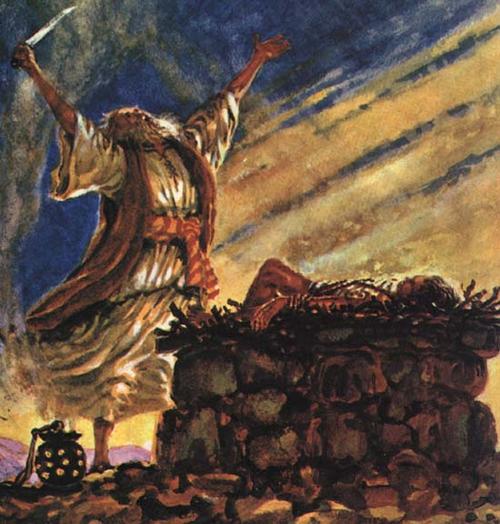
B. God called out Abraham and told him he would be the Father of the Jews, and his son Isaac was the seed for an upcoming society. Abraham and his wife soon had Isaac and he was perfect. The boy was so perfect that Abraham loved him more than anything in the world. To be chosen required Abraham to experience a radical sacrifice. God revealed to Abraham that he wanted him to offer his perfect and only son as a sacrifice. Abraham was confused and disturbed, but he reluctantly left with Isaac and grimly walked to the mountain. When they arrived, Abraham was ready to burn Isaac. God, seeing Abraham’s devotion to him and his willingness to destroy all he loved for Him, called for him to stop and take a lamb instead. By calling out to Abraham, the Father of the Jews, he chose a people to serve him and lead the world in redemption. Isaiah thought the Jews answered God’s call and He established a covenant with them. It expressed that they were chosen to shoulder the suffering, which would have been experienced by more people if the world had heard the same call as Abraham. God has put the Jews through many trials, such as slavery, emanate extinction, and occupation. The story of the Jews has been one filled with suffering and sadness. Through this suffering new ideals of justice have been born unto the world. Through constant exodus, the Jews preached a prophetic principal that deduced a king’s power to that of peasant in the eyes of God. This idea of equality revolutionized the Western world; in that people no longer felt the need to submit to kings that are corrupt or exploitive and a revolutionary spirit was spread. God would not put up with uncompassionate governments. The Jews were chosen to fix the fabric that held society together. Ever since Abraham, the Jews have felt the suffering and awe he felt as he was about to light Isaac on fire. Through this suffering they found meaning, and forever changed the social fabric by reducing kings to men of God.


In the film The Matrix, Neo is a man living in the mundane. He spends his time pondering the meaning of reality and the fabled Matrix. One day, a man named Morpheus calls him out to free humanity from the Matrix, which enslaves Man’s mind in a virtual reality. Neo has the comforts of the mundane life, but is asked to sacrifice all he knows and feels to enter a foreign world. He must let go and sacrifice his life inside the Matrix to fulfill a prophecy. He does this in the form of a pill and he is taken to a cold world where humanity is enslaved and only a few, the people of Zion, are awakened. Soon, the forces require that Neo lead Zion to freedom from their enslavers. He does so with the help of his people. They suffer many casualties, even Neo himself is killed. Neo was chosen along with his people, as was Abraham, to save humanity, just as the Jews are chosen to be God’s leaders in the hallowing of nature. As God decreed to the Jews that all men are equal under Him, Neo strikes a truce with the enslavers and creates equilibrium between the rulers and the freed slaves.

C. Judaism champions the prophetic view of the redemption of the world. In the end of times, good and evil will still exist. The prophetic view allows evil to find a path to God. The apocalyptic view has an unmistakable schism between good and evil that can never be bridged. The apocalyptic camp considers the evil ones unredeemable and has themes of the world being doomed. On the side of the prophetic, the earth will be hallowed, God’s original plan for earth will be fulfilled, and His Kingdom will be complete. Apocalyptic views of nature consist of God abandoning nature and destroying it if evil has touched it. This poses a problem because it lets wickedness take control of nature. This poses the question: how powerful can God be if his creation can be stripped of him so quickly? The key to prophetic views of salvation are that people play a hand in it. God wills man’s help to prepare for the hallowing of life. There is no science to the world’s salvation; it is up to man and God. The apocalyptic view believes there to be a science to the end times and it is unalterable and unmovable. It takes man’s hand out of the equation, and it just happens. This is the main rupture Christianity has taken from Judaism. Martin Buber believes that early Christianity adapted the apocalyptic views from Iranian dualism, which has a very cyclical view of the end times.


In the film The Matrix Reloaded, Neo stands before the Architect and two doors. The first door leads to a complete reset of the Matrix, or reality. Everyone is affected by it and no one is left behind. The Architect informs Neo that the first door has been taken many other times, by his predecessors and the resetting of the Matrix is a normal, mathematically-controlled variable. This door is for the prophetic view because everyone is affected. Evil and good both receive the same ending. The next door is a path back into reality where Neo’s actions will affect the future of the Matrix. The Architect informs Neo that he will be driven by love if he chooses the second door. This door would be for the apocalyptic. Of course, Neo follows his heart and take the apocryphal path because it involves freewill, unlike the happy ending put forth by the prophetic views.

Critique:
The prophetic look at end times, as posed by Martin Buber, seems to lack the notion that man has been given undeniable freewill. As the prophetic view delves into the end times, we see a blurring of good and evil. Accordingly, evil can be led back to God, which poses a problem, because an evil person has made a choice to be evil. God puts the choice in front of man, to be good or evil; we do not draw sticks or roll dice to see which camp we belong to. We, as humans, can choose the path of good or evil. Why has God given us the choice if in the end we will all end up with him no matter what? The apocalyptic view holds freewill into account. It notes that a man has turned to evil by his own doing and at anytime can take the path back towards good. According to a Christian, if you choose evil you are damned, unless you take the path back to good. The prophetic views of end times are very accepting and show man that we can stray, but in the end, we will all be okay. There is no need for freewill if the greatest choice in our lives is void. It would make more sense in Judaism that God would hold good and evil accountable in the end. Jews should have a better understanding of God’s mercy and duality of justice because they feel they have experienced both intimately. It doesn’t make sense that God would plague Israel with a line of naïve kings, just for forgetting that He is their only king, but allow those who make a conscience choice to do evil deeds join him in the end. This is where the Christian and the Muslim worlds see the folly of the prophetic view and hold that evil will get what it deserves in the end.

Building the Table: Islamic Structure


A. According to Islam, Muhammad is the seal of the prophets. This means that Muhammad is a reassertion of God’s will and that he is the final prophet. Islam believes that Abraham, Moses, Jesus, and Adam were all prophets, but that Muhammad was the culmination of their prophetic vision. They believe that the other prophets’ messages have been distorted through translations by the hand of man. Man’s involvement in the compiling of scriptures has disenfranchised them. This gives way for the Quran to build on those scriptures as the final word of God. This is what sets the Quran apart from pre-Islamic Abrahamic scriptures. The Quran is accepted as the direct word of God as recorded by Mohammed and his men. To a naysayer, this might appear to be a crazed man, running around telling others to record his channelings from God. Why did the direct word of God never come before? Muhammad believed humanity was not ready for it. To Muslims, the old prophets and scriptures were historically-based and simplistic so that humanity could grasp them at the time. Muhammad came along with the final revelations because humans were ready to hear it. Muhammad and Islam’s massive success didn’t come until the Hijra. Muhammad had a following in Mecca and the Meccan nobility was treating him and his people as a threat. Muhammad saw this and took a deal with Yarthrib, a city north of Mecca, to fix splitting factions within their leadership. The Muslims then migrated to Yarthrib, which later became Medina. This pilgrimage marked the start of the Hijra. During the Hijra, Muhammad became an excellent statesman and performed a miracle that united five tribes of the city, three of which were Jewish. Through his excellent state craft, he attracted people from all over Arabia. People flooded to Medina to see the prophet’s amazing governing abilities. Mecca was upset by this competition and sent armies to level Medina. After a couple battles, Muhammad counter-attacked Mecca and won. After speaking with the Meccan leaders he accepted the mass conversion of Mecca. The Hijra turned Muhammad into a world leader of sorts; by his death, he controlled most of Arabia. Even years after his death, armies of Muslims conquered most of the Middle East and Africa. Muhammad readied Islam to spread as easily as the wind blows.

The story of Abraham and Ishmael is a good example of Muhammad’s Hijra. Abraham has a son with servant Hagar, named Ishmael. He does so because his wife, Sarah, is unable to bear children. Many years later, Sarah surprisingly gives birth to Isaac. God soon tells Abraham to send Hagar and Ishmael into the desert with God's protection. Just as Muhammad had been cast out of Mecca, Ishmael was cast from his home. Muhammad ended up returning to Mecca and taking it back. Ishmael also made it to Mecca and is credited with building the foundations of the Ka'aba, just as Muhammad had built the foundations for Islam in Mecca. To reverse this example, Abraham and Isaacs’s relationship is another illustration of Muhammad’s claim to being the seal of the prophets. God promised Abraham that Isaac would be the seed of a great nation, and when he was born Abraham though he was perfect. He bore everything a son needed to be and was the seal of Abraham’s seed. Abraham then chose to send Ishmael, his eldest son, into the desert. Muhammad’s importance as the seal of the prophets is like Isaac in the eyes of Abraham. A perfect son that created a great nation. This parallels Muhammad’s creations through direct messages from God.

B. The ummah is the Muslim community. Allah works through the ummah to raise people’s eyes up to Heaven. Islam means unity and Allah expects Man to look higher than the kings, and have their eyes on Him. The Five Pillars of Islam are built on ummah. They reflect the trials and experiences Muhammed encountered with the early Islamic Ummah. To gain admittance to the community, one must first accept the Shahadah or Islamic creed that Allah is the only God and Muhammad was his prophet. This must be done on an individual basis. Another individualistic task is the daily prayers; they constantly remind Muslims that they must submit before Allah. By having each person perform this prayer at the same time, the community keeps their social dealings in perspective with God. Ramadan fosters compassion and social cohesion through fasting. By fasting, they not only commemorate Muhammed’s revelation and Hijra, but also pull Muslims together to feel the hunger of the poor. This leads into the next pillar of Zakat, or charity. The Quran specifies that a basic tax of 2.5% must be given to the poor and hungry. The final pillar, which best represents the spirit of the Islamic community, is the Hajj. This pilgrimage back to Mecca champions equality among the Muslims and shows their ability to stand as a community under Allah. These five pillars provide a simple groundwork to identify oneself as a Muslim on a broad level. The day-to-day laws of the ummah are the shari‘a. The shari‘a gives guidance from the Quran and the Hadith to lawmakers, so that they can better institute Islamic law. The ummah must be united under these laws to exist. The culmination of these laws creates a universal brotherhood among Muslims. The ummah is connected among people, not countries. It has no national boundaries. The laws and pillars of Islam provide unity among all Muslims, unlike many religions which only direct the individual’s path.

For the purpose of this example, we shall assume that a table needs and relies on five legs to stand. The legs are the five Pillars of Islam. Attached at the top of the legs is a broad table top. This table top represents the Islamic law, Shari ‘a. Standing on top of the table is the Islamic ummah, which requires the table’s support to stay connected. If a pillar falls off or the table top cracks, it could all fall down. To prevent this from happening, the table needs constant repair and upkeep by the people standing on it. Through this constant upkeep, the ummah is formed through an interconnecting brotherhood that depends on the table.

C. Ali is the origin of the Shi’a and Sunni split. Sunnis view Ali as the fourth and last of the caliphs following on from Abu Bakr, Umar, and Uthman. Sunnis believe that the caliphs are to be chosen by the community; blood ties with Muhammad is not a requirement. Shi’as believe that Ali was the first caliph and because of this, the caliphate only passes through direct descendants of Mohammed. Uthman was murdered and Ali became caliphate. Ali soon had to fight Mu'awiya Ummayad who refused to recognize Ali as the Caliph. Ali compromised with Mu'awiya, and upset his supporters, who felt betrayed and killed him. Mu'awiya declared himself to be the caliph. Mu'awiya finally died and his son, Yazid, took over the caliphate. Hussein, Ali’s son, led an army against Yazid, but he was slaughtered and beheaded. Hussein’s death was the final divide between the Shi’a and Sunni. The Shi’a believe that imam is the spiritual leader of the community. Ali was the first imam and his successors were the only true imams. The imam tradition ended with Muhammad al-Mahdi al Hujja, who disappeared in a cave, but would reappear every once in a while. He finally appeared for the last time as the Mahdi, or expected one. This was the golden age of Shi’a Islam. Now, the imam’s influence is representative and there is no physical imam living. Sunnis, on the other hand, look at the imam as just a person who leads services at a mosque. The theological differences of Sunni and Shi’a are minor. The basis of the two tribes’ division is a historical and political feud.

Imagine there is a faceless coin. This coin is Islam. The coin is shared by two friends who mean for the coin to be equal forever. One day, the friends have an argument and one of them stamps his face on one side claiming ownership of the coin. The other friend is upset by this and stamps his face on the other side. Now, the coin is split because of a feud and the coin adorns two faces. Though at the root, it is still a coin. This illustrates the Sunni and Shi’a split over the caliphates. They may look different and on the surface seem to be different, but they are still Islam.

Critique:
My biggest problem with Islam is that it proposes kingdoms and countries be run by Islamic law. The Quran’s laws are a product of their time. Back when Muhammad started receiving Allah’s message, Mecca was a distraught and corrupt place. Mass orgies, lawlessness, and other social dysfunctions were commonplace. Islamic law is based on the eradication of these corruptions. The world is a little more stable now, but Middle Eastern countries still use this Islamic law to rule their people. The wealthy leaders of Saudi Arabia use it to keep lower classes poor and keep themselves rich. Sudanese warlords use it as an excuse to slaughter thousands of innocent people. Who are the people to argue Islam’s law when interrupted by a dictator? The fact that the Quran is the direct word of God strikes fear into the people who challenge the dictator’s reign of exploitation. If the world leaders were true to the Quran and sought to fight hunger and poverty, then we wouldn’t see the large poverty rates in Islamic countries where the leaders live with the spoils of ancient kings as they step on the backs of the people. We see this happening in the west as well, but it’s not under the façade of divinity. The use of Islamic law would be more acceptable if leaders were companionate and cared for their people. Unfortunately, this is not the case; they only care about their riches and use Islam to extort the people. The post-colonial world isn’t so romantic and leaders don’t lease with their heart. They lead with ideas of power and wealth.